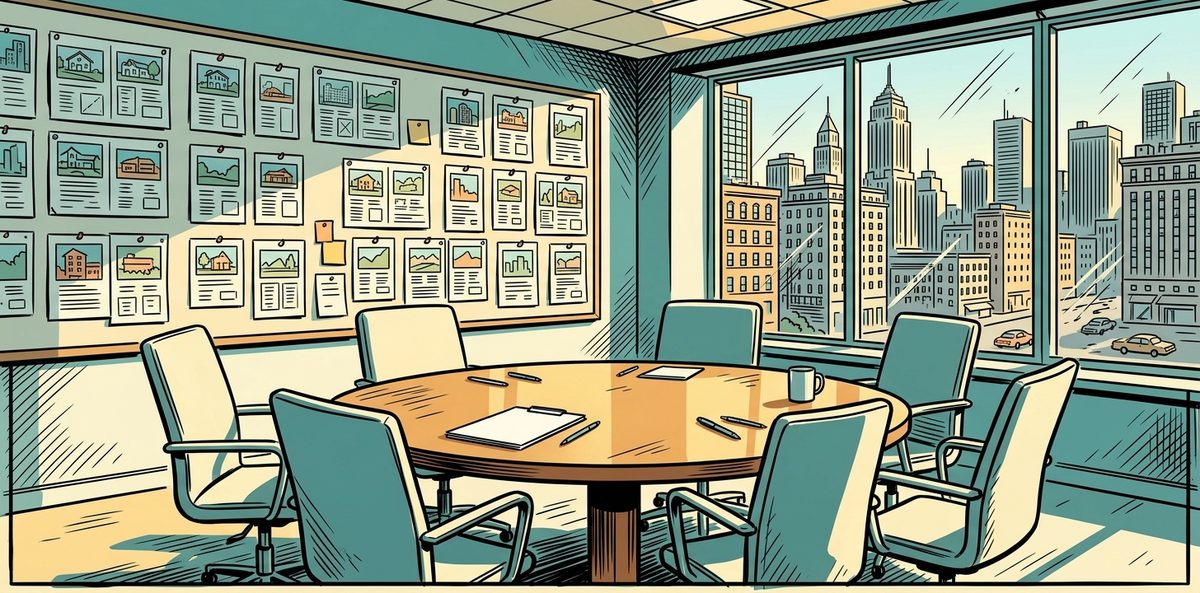
Leadership Team (subagent boardroom)
AI boardroom of six subagents writes its own minutes to Markdown.
An AI boardroom that holds a weekly meeting and writes its own minutes back to a Markdown file. Six subagents — Marketing Director, Chief Researcher, Editor-in-Chief, AI Engineer Lead, Coordinator, Mentor — each with its own role prompt, knowledge files, and persona.
Every Monday, the Coordinator runs the meeting. Each role contributes a weekly report. They make decisions, assign owners, surface conflicts. The Coordinator writes the minutes back to a Markdown file. Next Monday, it reads last week's minutes before drafting the agenda.
That's it. The whole "boardroom" is six roles, a coordinator, and a Markdown file.
The interesting part is the persistence layer — flat Markdown files. To know what the boardroom decided three weeks ago, open the file. To fix a bad decision, edit it. To back up state, copy the folder. The whole memory layer is durable, debuggable, version-controllable, and human-readable without any infrastructure.
Most "agent memory" architectures assume you need vector stores, embeddings, retrieval pipelines — fancier persistence with operational cost attached. For a system like this, where the agents need to recall structured decisions and not search across a corpus, a flat file is the right database. Less to break, easier to debug, free to back up.
The pattern generalizes. Plenty of agent use cases involve recalling structured prior decisions rather than retrieving from a knowledge corpus. For those, plain text is enough.