One Ipoh host, fifteen listings, and the price for each season.Illustration · Data Stories Lab
Pricing & hospitality
Right Price, Right Season
Price each Airbnb listing right for each season
Data Stories LabAnalyst report15 Ipoh listings · seasonal pricing
This report reviews the sales history of a 15-listing Ipoh Airbnb portfolio to answer one practical question: what should each place charge at different times of the year to make the most money? It finds the busy and slow periods, measures how bookings respond to price for each property and season, and turns that into a clear rate for every listing. It is written for the host who sets the prices, so it stays in plain language and ends with a list to act on.
The six questions below run in order, from what is happening to what to do about it. Questions one to four show the pattern: when the seasons fall, how sensitive each property is to price, and whether the numbers can be trusted. Questions five and six turn that into a month-by-month price sheet and the money it is worth.
The numbers
RM254k
extra profit
9.5%
more profit
21 / 100
studio bookings lost
~57%
occupancy held
“The most useful finding is that one flat pricing rule is the wrong tool, and it costs about RM254,000 a year.”
What the data shows
Executive summary
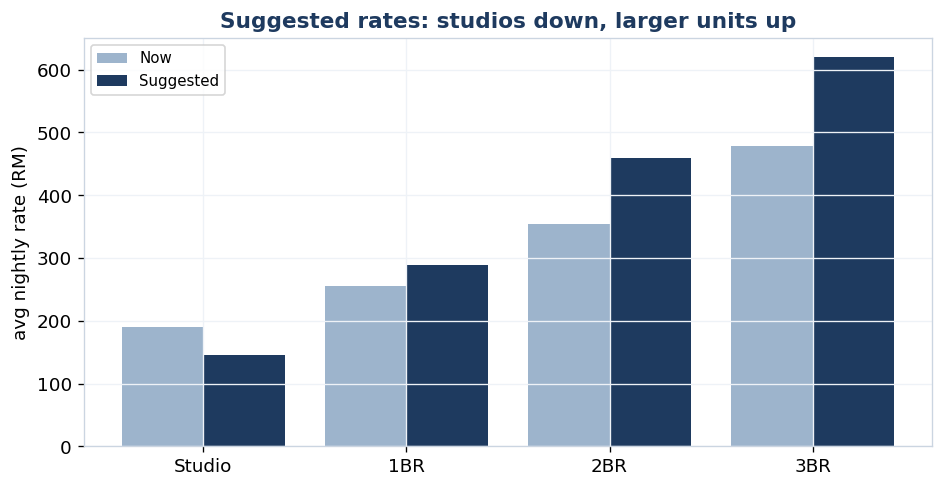
A host runs 15 Ipoh Airbnb listings and prices them with one seasonal rule. That rule misreads how differently each place reacts to price: studios sit too high and run empty nights, while the larger apartments sit too low and leave money behind. Pricing each place to its own demand, season by season, lifts profit by about RM254,000 a year (about 9.5% more), with occupancy holding near 57%. The plan is simple: cut studio rates, and raise the larger units, the quiet season first.
1. When are my peak and slow periods?
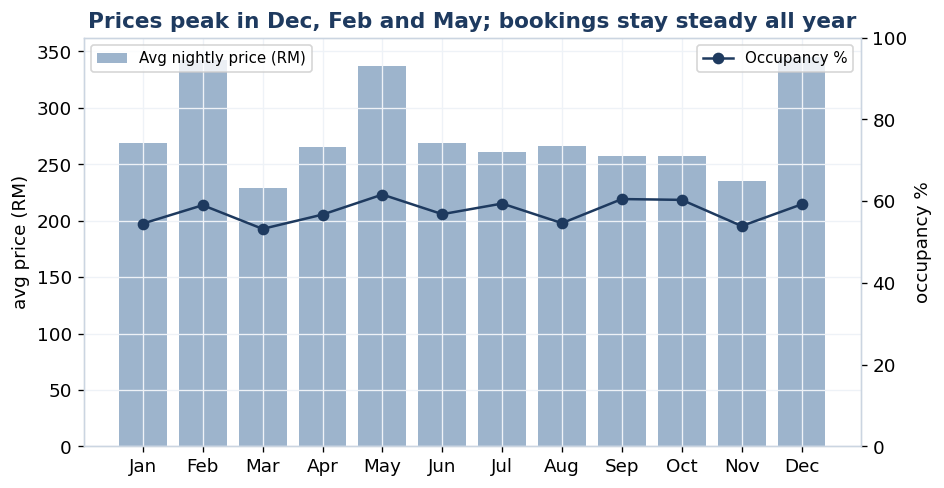
The year splits into three seasons, set by month. Peak is December, February for Chinese New Year, and May. The quiet months are November and March, and every other month is shoulder.
Bookings stay near 57% all year. That is because prices already rise in the busy months. So the season shows up most in price, about RM341 a night in peak against RM232 in the quiet months.
Start every pricing decision from the month's season. May is the busiest month and March the slowest. Read the season first, then set the rate.
2. When I change a price, how many bookings do I lose?
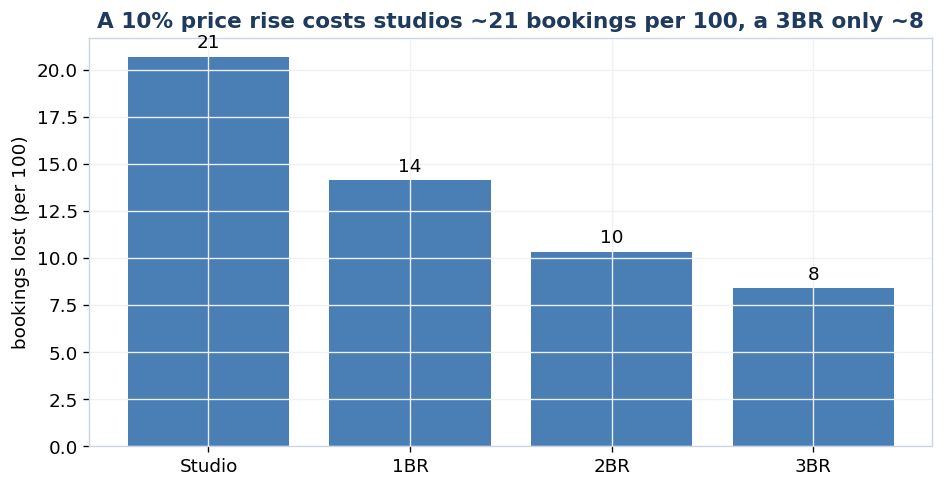
It depends on the property. Raise a studio price by 10% and you lose about 21 bookings in every 100. Do the same to a three-bedroom and you lose only about 8.
Studios are easy for guests to swap. Bigger units are chosen for the space, so guests will pay. One and two-bedroom places sit in between, near 14 and 10.
Never move every listing by the same percentage. Studios and big units should go in opposite directions. Price each type to how much its guests care about price.
3. Does that sensitivity change with the season?
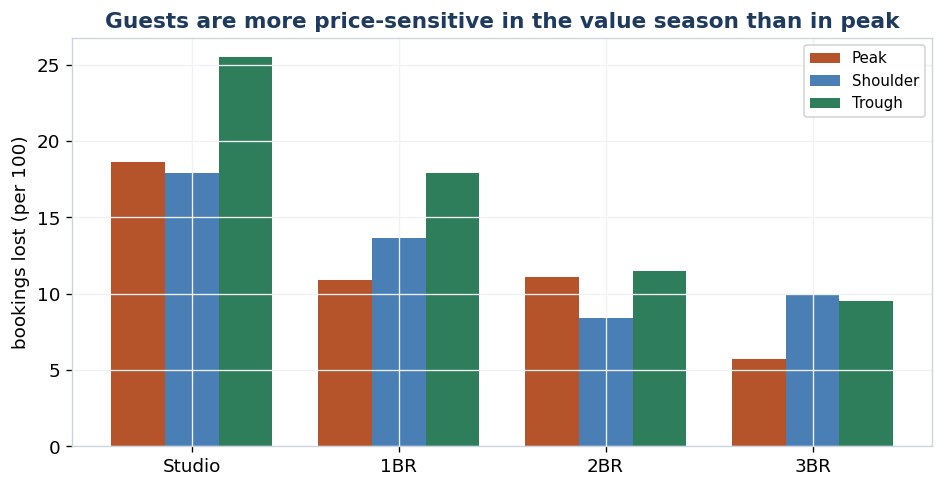
Yes, it shifts with the season. In the peak months guests care less about price. In the quiet months they care more.
A studio loses about 19 bookings per 100 in peak for a 10% rise. In the trough it loses about 26. The same place needs a different price in December than in March.
Do not use a single peak and off-peak switch. Set a rate for each property in each season. Season matters as much as the property.
4. Can I trust these numbers?
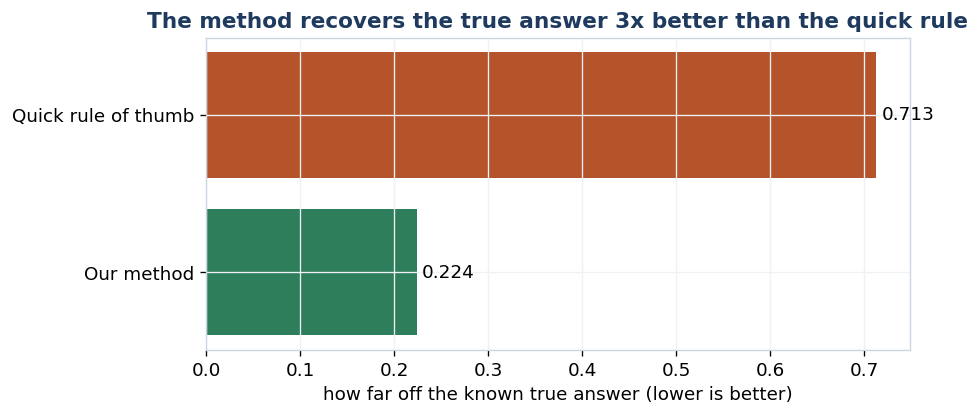
Yes, and we tested it. We ran the method on data where the true answer was known. It landed very close to the truth.
It was about 3 times more accurate than the quick rule most tools use. The true value sat inside our expected range in all 12 checks. The quick rule wrongly says guests barely care about price.
That quick-rule error is what leads hosts to overprice. Our numbers avoid it. Re-run the check each quarter as new bookings arrive.
5. So what should each property charge, month by month?
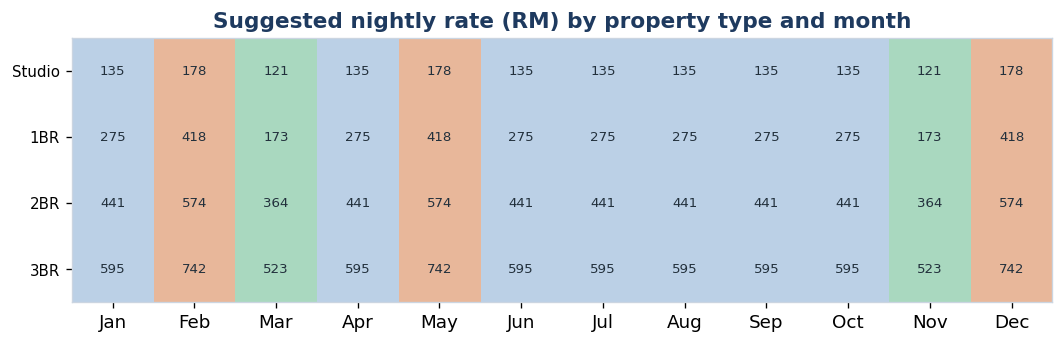
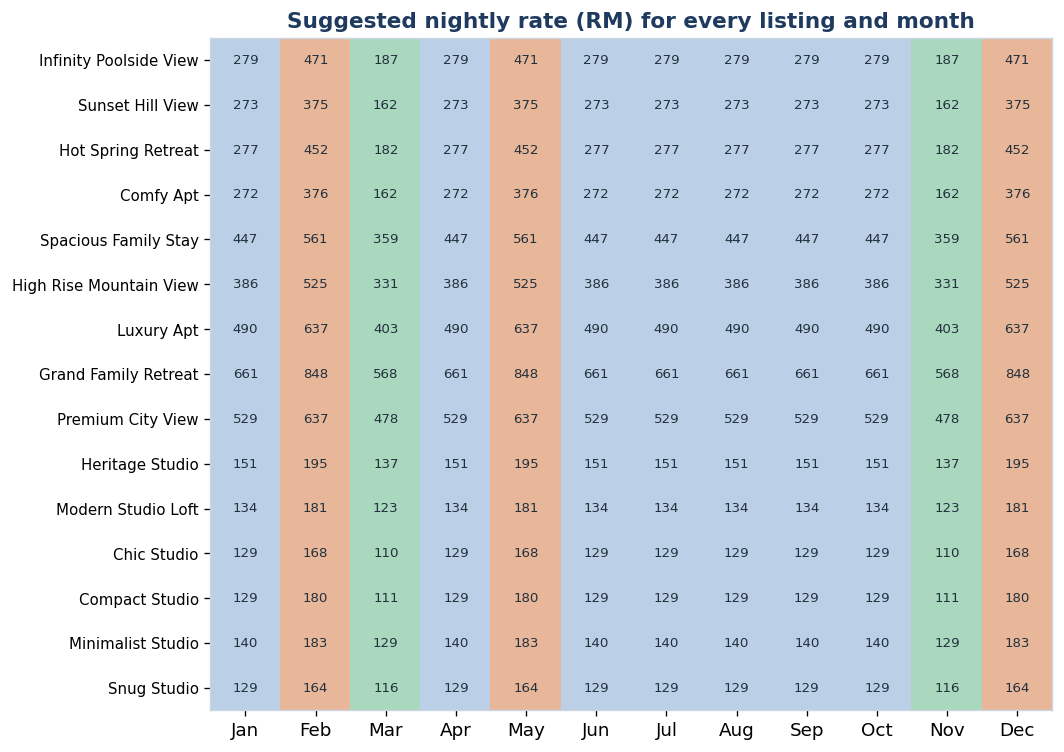
This is where the findings become prices. Each month's season sets the level, and each property's sensitivity sets the direction. Of 45 price points, 23 go up and 22 come down.
Studios come down to win back empty nights. The larger units go up, because their guests will pay. Every rate is highest in the peak months and lowest in the value months.
The price sheet below gives the rate for every property and month. Apply your usual weekend premium on top. Move in steps and watch occupancy.
6. How much more will this make me, and when?
About RM254,000 more a year. That is roughly 9.5% more profit. Occupancy holds near 57%.
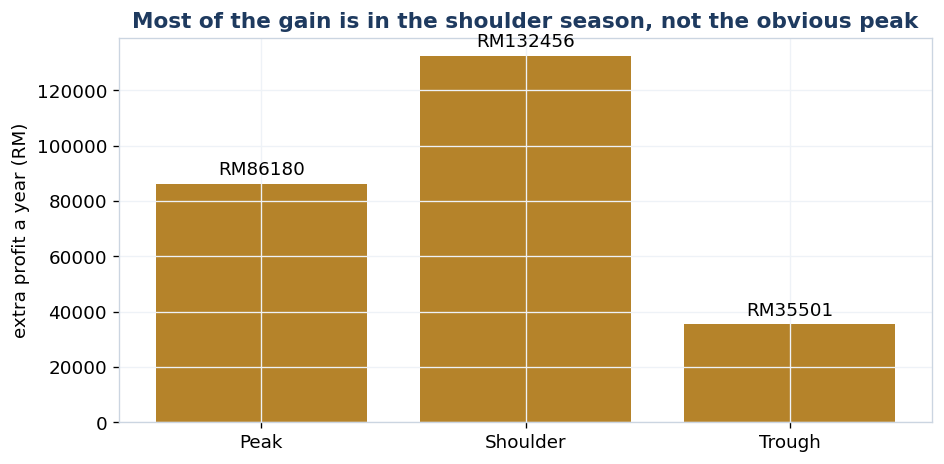
Most of the gain is in the shoulder season. That is where the larger units are most underpriced. The obvious peak is not where the money hides.
Start with the bigger units in the shoulder months. That is the fastest return. Then roll the new rates across the rest.
Recommendations
Cut studio rates toward their sweet spot. Studios lose about 21 bookings per 100 for every 10% rise, the most of any type. Lowering them wins back the empty nights that high prices are costing, and lifts occupancy without touching the bigger units.
Raise the two and three-bedroom rates, the shoulder season first. These units lose only about 8 to 10 bookings per 100 for a 10% rise, so their guests will pay more. The shoulder season is where they are most underpriced, and it holds the largest share of the gain.
Replace the one flat rule with a per-property, per-season price sheet. Sensitivity changes by both property and season, so a single peak and off-peak switch is too blunt. The price sheet gives the exact rate for every listing and month.
Set prices from the season calendar. Read a month's season first (peak, shoulder, or value), then apply that property's rate. This keeps pricing consistent and removes the guesswork.
Re-estimate every quarter. The method is validated against a known answer, so it is safe to act on. Refresh it as new bookings arrive so the prices keep tracking real demand.
Method & data
We analysed three years of nightly records for 15 Ipoh listings (16,440 listing-nights): the date, the listing, the price set, whether the night booked, the revenue, and the cost of servicing a booked night. We measured how bookings respond to price for each property and season, separating the price effect from the busy-season effect and from weekends, then checked the method against data with a known answer. We calculated the price that earns the most for each place and season, after costs, and held every recommended rate within prices the listings have already charged. The dataset is synthetic and fully reproducible, built to mirror real Ipoh short-term-rental patterns; the goal throughout was to set the nightly rate that earns the most for each property in each season.
Conclusion
The most useful finding is that one flat pricing rule is the wrong tool, and it costs about RM254,000 a year. The mispricing runs both ways: studios are too dear for their price-sensitive guests, and the larger apartments too cheap for guests who value the space. Counting on a single rule hides both problems at once.
Most of that lost money sits in the ordinary shoulder months, not the obvious peak. A host who only adjusts peak rates misses the bulk of it. The fix is a price for each property in each season, at no extra cost beyond setting the rates.
The recommended direction is to price by season and by property, using the month-by-month sheet. Cut the studios, raise the larger units, and start in the shoulder season. The same listings then earn more from the same demand.