A beachfront resort fills to capacity as the holiday season peaks.Illustration · Data Stories Lab
Demand forecast · Hospitality
Plan for the Peaks
Bookings double by season, with no yearly growth
Data Stories LabAnalyst report120 rooms · 2022–2024
This case study reads three years of monthly bookings for a 120-room Langkawi resort to answer one practical question for the manager: how full will each month be next year, and what should that change about staffing, pricing and promotions?
The resort is steady over the year but swings hard inside it. The findings below show which months are busy and which are quiet, how big the gap is, whether the resort is growing, how full it gets at each extreme, and what the coming year should look like month by month.
The numbers
1.99×
busiest vs quietest month
94% / 52%
full in peak vs quiet month
+2.1%
change over 3 years
2.5%
forecast error, tested
“The resort is really two businesses in one: nearly full in the busy months, half-empty in the quiet ones.”
What the data shows
1. When is the resort busiest and quietest?
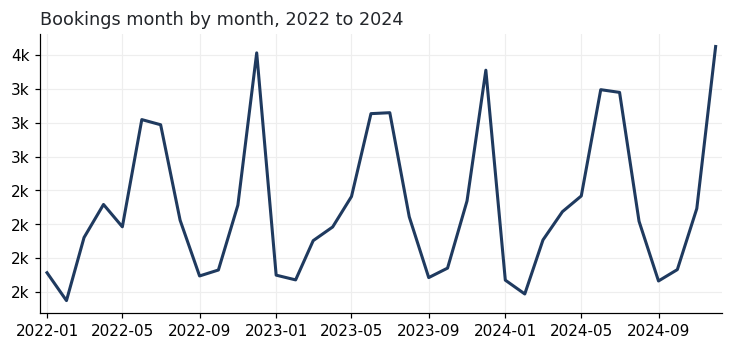
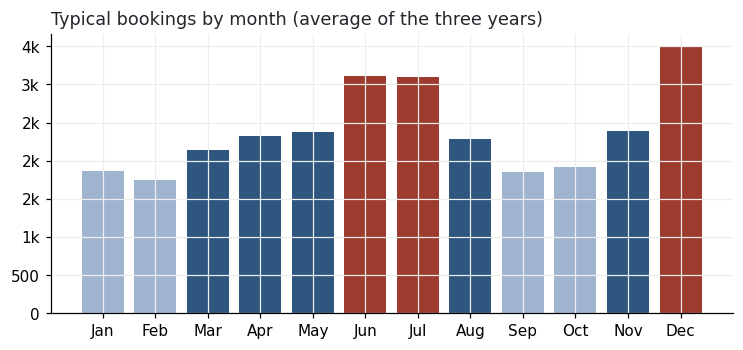
Bookings climb to their highest in June, July and December, and fall to their lowest in January, February, September and October. The same busy-and-quiet pattern returns every year, following the school holidays and the year-end season.
Because the pattern is so regular, the busy and quiet months are known a full year ahead, so staffing, room rates and offers can be set around this calendar before the year starts rather than reacted to month by month.
2. How big is the gap between busy and quiet months?
A busy month brings in around 3,500 room-nights against only about 1,750 in a quiet one, roughly twice the business. One fixed level of staff or stock set for the whole year is therefore wrong almost every month.
Planning to the yearly average over-resources the quiet months and under-resources the busy ones, paying for empty rooms one month and running short the next, so each month should be sized to its own expected demand.
3. Is the resort growing, or holding steady?
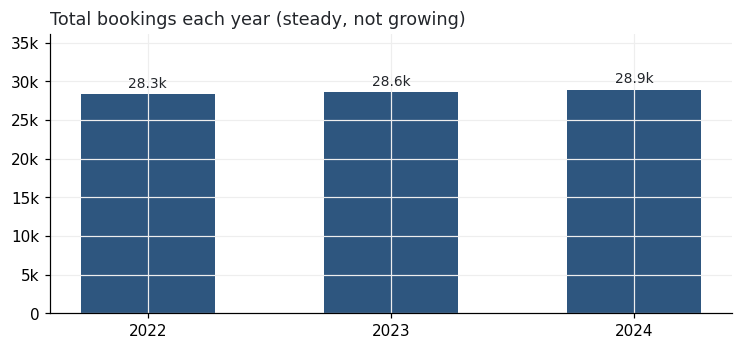
Total bookings barely moved across the three years, a change of only about 2%, too small to count as real growth. The resort is steady, not climbing.
Next year should be planned at today's level rather than a higher one, since budgeting for absent growth would over-stock and over-staff all year; any genuine rise is best treated as a bonus to confirm as bookings come in.
4. How full is the resort in the busy months?
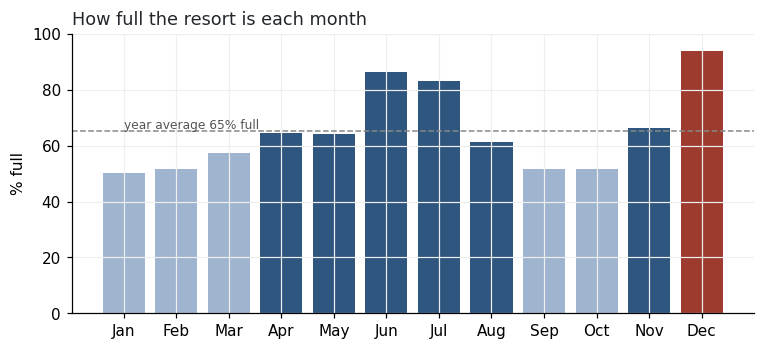
In the busy months the resort runs near 94% full, about as full as it can practically get once rooms need cleaning and turnaround between guests. At that point it runs out of rooms before it runs out of guests.
When a month is almost full, selling more nights is not possible, so the only way to earn more is the room rate. Holding firm prices and minimum stays through June, July and December protects the money those months already bring in.
5. How many rooms sit empty in the quiet months?
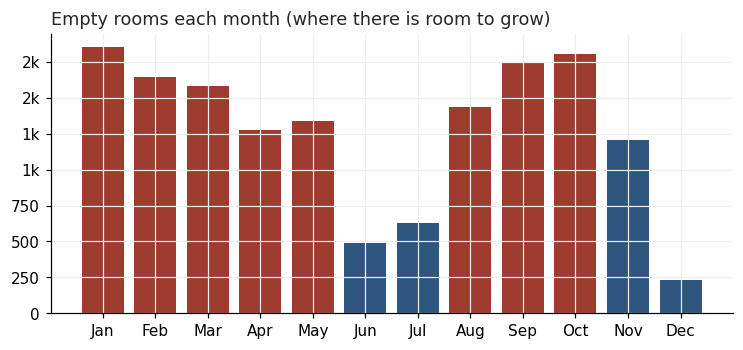
In the quiet months the resort is only about 52% full, against a 65% yearly average, leaving close to half the rooms empty while the staff and running costs behind them still have to be paid.
These empty rooms are the real room to grow, and the quiet months also run on a smaller team, so promotions, packages and maintenance belong in January, February, September and October, with staffing scaled down to match.
6. What can the resort expect in 2025, and can the forecast be trusted?
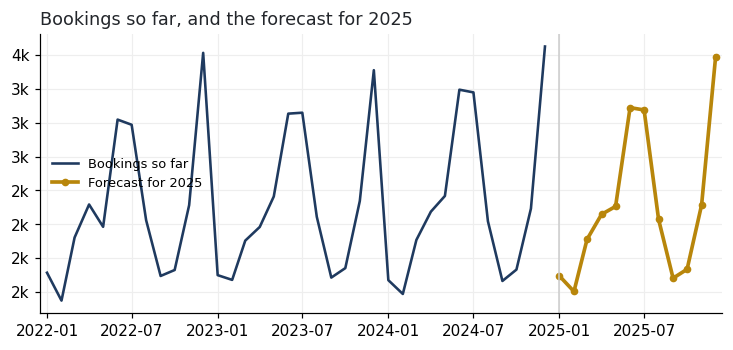
The forecast expects a busy December near 3,500 room-nights at about 94% full, a quiet February around 1,750 at 52%, and roughly 28,600 room-nights for the year, the usual seasonal shape carried forward on a steady base.
To check it, the most recent year was hidden and then predicted from the earlier years; the prediction came within about 2.5% of what actually happened, close enough to plan staffing and pricing against and to use the month-by-month figures as the operating baseline.
Method & data
We analysed 36 months of room-night bookings for a 120-room resort, January 2022 to December 2024. “How full” means rooms booked against rooms available each month. To forecast 2025, the resort's steady yearly level was adjusted up or down for each month's usual busy-or-quiet pattern, an approach chosen because the bookings are strongly seasonal with no real trend, where a method that chases a trend would read movement that is not there and even predict impossible figures. The forecast was checked three ways: it never predicted a negative figure, it came within about 2.5% when tested on a year hidden from it, and it matched a more complex statistical model while staying far easier to act on. The figures are well-grounded estimates rather than audited results.
Conclusion
The resort is really two businesses in one: a nearly full operation in its busy months and a half-empty one in its quiet ones, with no real growth from year to year. Running both on a single yearly plan quietly loses money at both ends, rooms selling out in the busy months when prices could be firmer, and sitting empty in the quiet months while costs carry on.
Because the pattern is so predictable, it is also fixable. The recommended direction is to replace the one yearly plan with a twelve-month plan sized to the season: hold firm rates and a full team through June, July and December; move promotions, packages and a lighter roster into January, February, September and October; prepare stock and hiring in the calmer months just before each peak; and plan next year from today's level, treating any growth as upside to confirm. The month-by-month forecast gives the exact figure to plan each month against.