Case Studies /Regression Analysis /What a Car's Worth
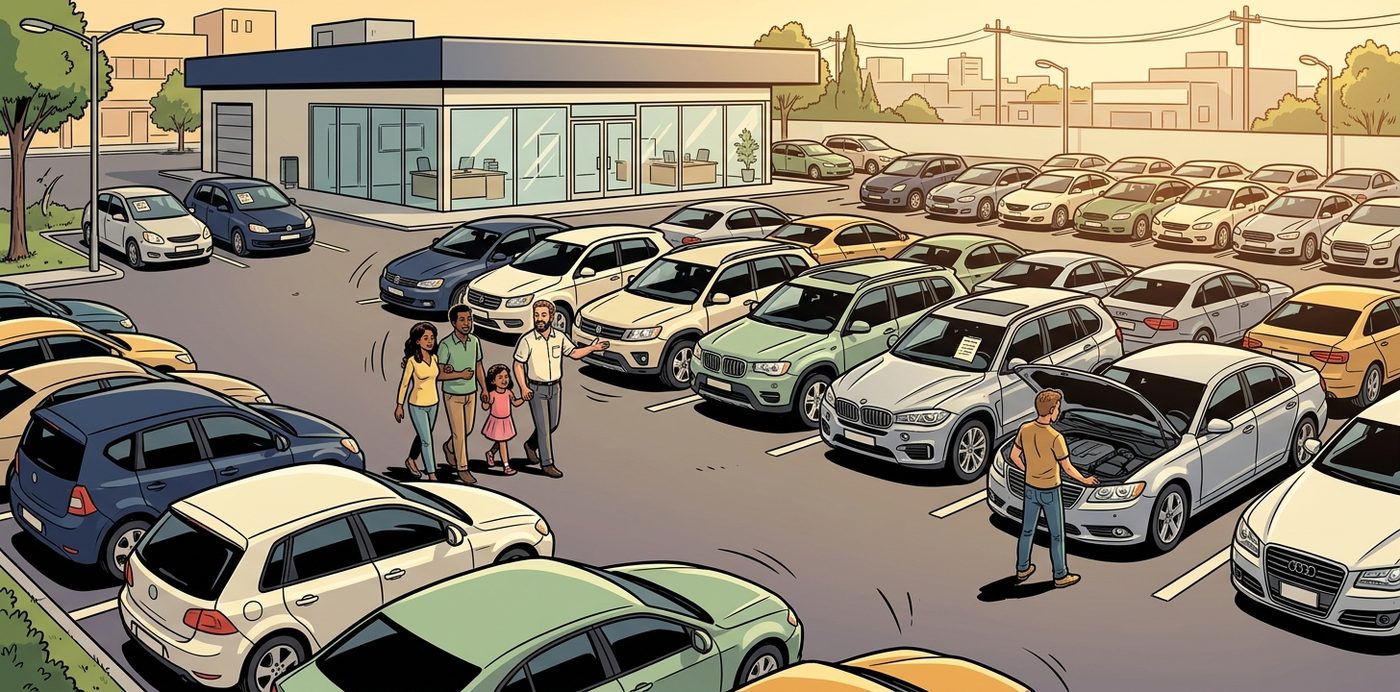
A used-car forecourt priced by the numbers.
A used-car forecourt priced by the numbers.Illustration · Data Stories Lab
Pricing Analysis

What a Car's Worth

Mileage, age and brand set the fair price

Data Stories LabAnalyst report400 cars · 5 brands

This report reads 400 used cars to answer one practical question for the dealer: what is a fair price for a given car, and which details decide it? Each car records its selling price along with its brand, age, mileage, engine size, transmission and number of previous owners.

The findings below show which features set the price, how much each one is worth, how reliably a fair price can be estimated, and how the method prices very different cars.

The numbers
94%
of price differences explained
RM 2,649
off per year of age
RM 1,785
off per 10,000 km
9.0%
how close the price estimate was

“A used car's price is not a mystery: four plain features explain almost all of it.”

What the data shows

1. What sets a used car's price?
chart

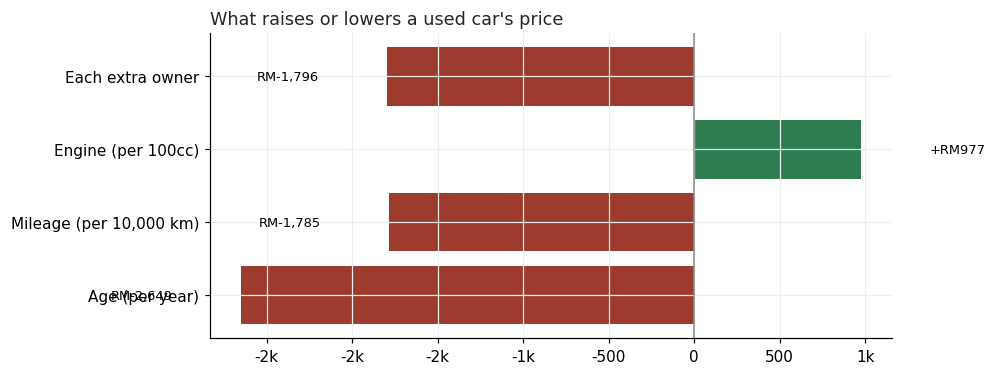
Four things explain almost all of it: the brand, the age, the mileage and the engine size. Together they account for 94% of the difference in price from one car to the next, so very little is left to luck or haggling.

For a dealer this means a fair price can be worked out from a car's basic details, rather than judged by feel. The same logic values a trade-in, sets a forecourt price, and spots a car that is priced wrongly.

Use these few details as the backbone of every pricing decision, and treat large gaps from the expected price as a signal to look closer.
2. How much does mileage take off the price?

chart

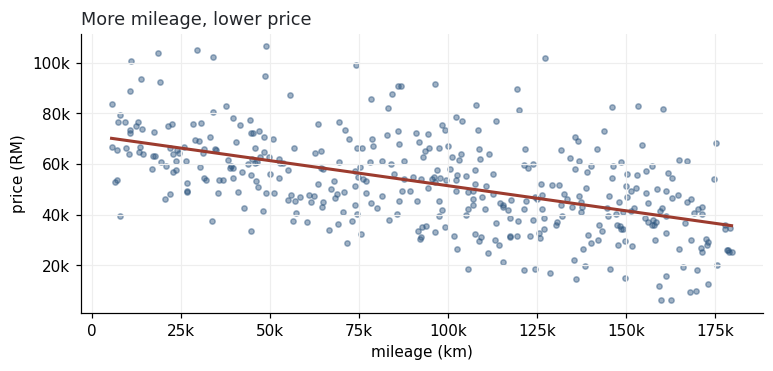
Mileage steadily pulls the price down. Every 10,000 km on the odometer lowers the value by about RM 1,785, holding everything else equal. A car with 100,000 km is worth roughly RM 17,850 less than the same car barely driven.

This makes the odometer one of the clearest levers in a negotiation. A high-mileage car is not simply less desirable, it has a measurable discount attached.

Adjust the asking or trade-in price against a typical car's mileage, rather than treating all examples of a model the same.

3. How much does age take off the price?

chart

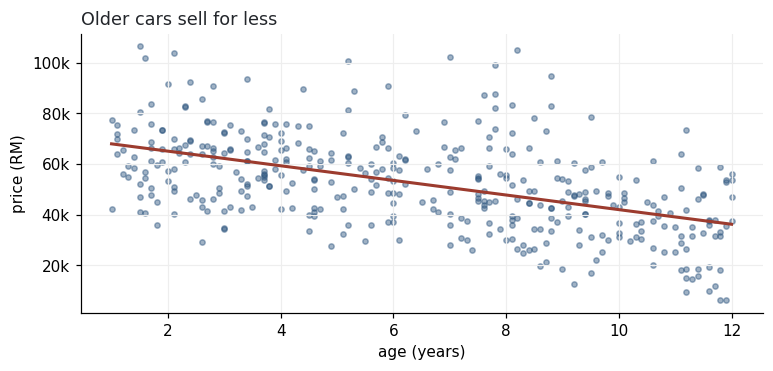
Age works the same way. Each extra year lowers the price by about RM 2,649, on top of whatever the mileage does. A five-year-old car carries roughly RM 13,245 of age-related drop built in.

Age and mileage are separate discounts that stack, so an old car with high mileage is marked down twice. This is why a low-mileage older car and a high-mileage newer one can land at similar prices.

Price age and mileage as two separate deductions, and watch for cars where only one is bad, they are often the better buys and sells.

4. How much does the brand matter?

chart

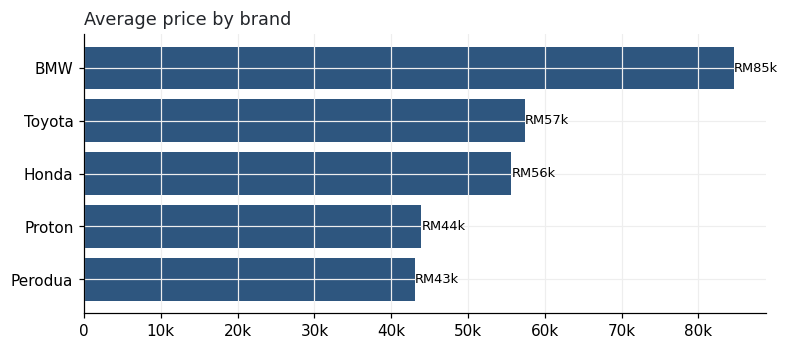
Brand is the single biggest factor. Holding age and mileage equal, a BMW is worth roughly RM 27,898 to RM 41,938 more than a comparable mass-market car, with Perodua and Proton the most affordable and Toyota and Honda in between.

So two cars of the same age and mileage can be worth tens of thousands apart purely on the badge. Brand is not a soft preference here, it is the largest number in the pricing.

Anchor each car to its brand first, then adjust for age and mileage, rather than pricing across brands on mileage alone.

5. Can a fair price be estimated reliably?

chart

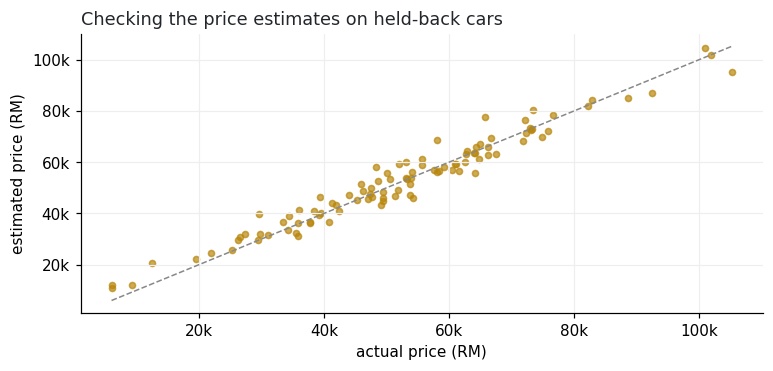
Yes. Tested on cars held back from the analysis, the estimated price came within about 9.0% of the actual selling price, with no consistent over or under-valuing. For a typical car that is an error of a couple of thousand ringgit, not tens of thousands.

That is accurate enough to use as a working valuation: a quick, defensible number for a trade-in offer or a forecourt sticker, backed by the data rather than gut feel.

Use the estimate as the starting price and negotiate around it, treating it as a reliable anchor rather than a guess.

6. How does it price a real car?

chart

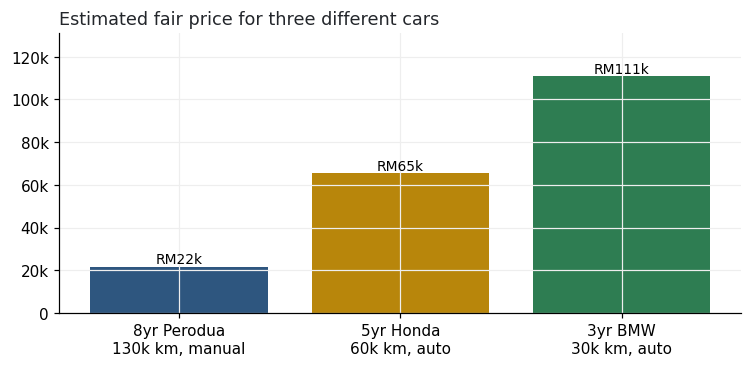
The method prices any car from its details. A budget example, an eight-year-old Perodua with 130,000 km, comes out near RM 21,712; a mid example, a five-year-old Honda with 60,000 km, near RM 65,493; and a premium example, a three-year-old BMW with 30,000 km, near RM 110,988.

Each price is built the same way: start from the brand, then subtract for age, mileage and owners, and add for a larger engine. The result is a consistent, explainable number for every car on the lot.

Run each car through the same factors so the whole forecourt is priced on one consistent basis, not case by case.

Method & data

This report is based on 400 used cars, each with its selling price, brand, age, mileage, engine size, transmission and previous owners. We measured how much each feature moves the price while holding the others steady, and confirmed the features were not overlapping or double-counting each other. Together they explain 94% of the difference in price, and on cars held back from the analysis the estimated prices came within about 9.0% of the actual selling price, with no consistent over or under-valuing. The numbers should be read as well-grounded estimates, not exact valuations.

Conclusion

A used car's price is not a mystery. Four plain features, brand, age, mileage and engine size, explain 94% of it, and each carries a clear price tag: a fixed amount per year, per 10,000 km, and a large gap between brands.

That lets the dealer replace gut-feel pricing with a consistent, defensible number. Every trade-in offer and forecourt price can be built the same way and lands within about 9.0% of the real market value, which protects margin and speeds up decisions.

The clear direction is to price every car on the same few factors: start from the brand, deduct for age, mileage and owners, add for a larger engine, and use the result as the anchor for buying and selling.