Which Channel Finds Your Tenant
Stop guessing where your leads come from
Executive summary
A Klang Valley rental agency was spending RM1,510 a month across five lead channels (PropertyGuru, Mudah.my, Google Ads, Meta Ads, and WhatsApp referrals) with no way to tell which ones produced signed tenants. Six months of data, 1,140 enquiries followed all the way to their outcomes, showed that the busiest channel signed nobody: Mudah produced 40% of all enquiries and zero tenancies, while WhatsApp referrals produced 9% of the volume and two tenancies at no cost. The agency should rank channels by cost per signed tenancy, not by enquiry count, formalize a referral ask at every signing, cap Meta to rooms, and recover the RM682 of paid leads it currently loses by not replying fast enough.
Overview
A property agent managing ten rental listings receives enquiries through five different doors, and each platform only reports its own numbers. PropertyGuru shows its chats, Mudah shows its messages, Google and Meta show their ad leads, and referrals arrive quietly over WhatsApp. The agent can see how many enquiries each channel brings, but not the only thing that pays the bills: which channel actually produces a signed tenancy, and what each tenant costs to find. Without that, the marketing budget flows to whichever channel looks busiest, which is rarely the one that works.
This report answers that question directly. It follows every one of 1,140 enquiries from first contact through to a signed tenancy, tags each with its source and its cost, and ranks the five channels by what matters: cost per tenant, not cost per lead. It is written for the agent deciding where next month's ringgit should go, and it pays particular attention to where money and attention are being spent on leads that never sign.
1. Do the busiest channels bring good leads?
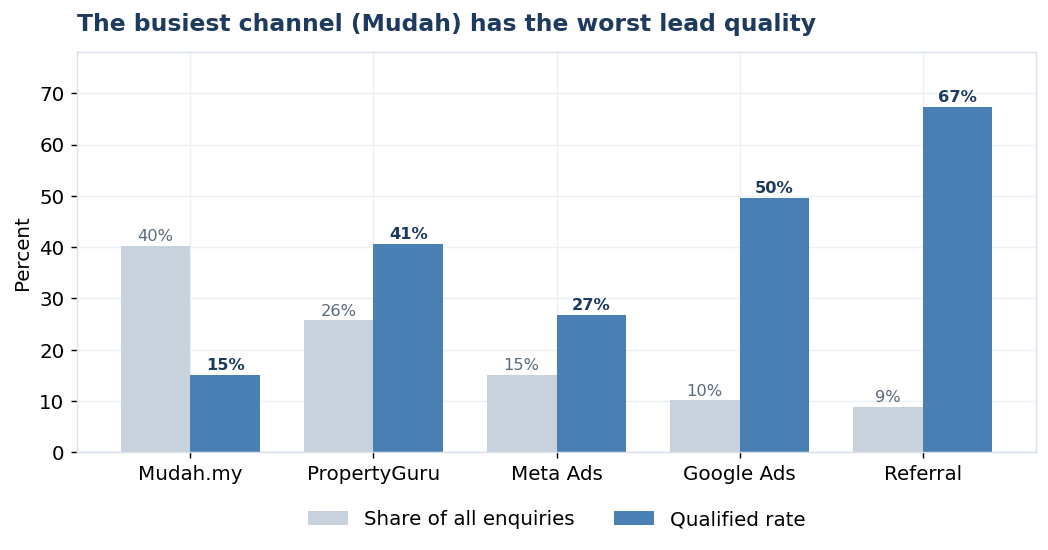
Volume and quality point in opposite directions. Mudah.my brought 459 enquiries, 40% of everything the agency received, but only 15% of them were qualified and just 5% ever reached a viewing. WhatsApp referrals sat at the other end: 101 enquiries, under a tenth of the volume, but 67% qualified and more than half reached a viewing. PropertyGuru and Google Ads fell in between, with Google converting cleanly (50% qualified) on low volume and PropertyGuru carrying the steady middle (41% qualified) on high volume.
The lesson is that enquiry count is a vanity number. A channel can dominate the inbox and contribute nothing, because most of its leads are unqualified, mismatched, or lowball offers. Ranking channels by how many messages they generate rewards exactly the wrong behaviour.
The agent should stop reading channel performance off raw enquiry counts and start reading it off qualified enquiries, the ones that match the listing and are ready to move within 30 days. On that measure the picture inverts: the smallest channels are the strongest.
2. Which channel signs tenants, and what does each one cost?
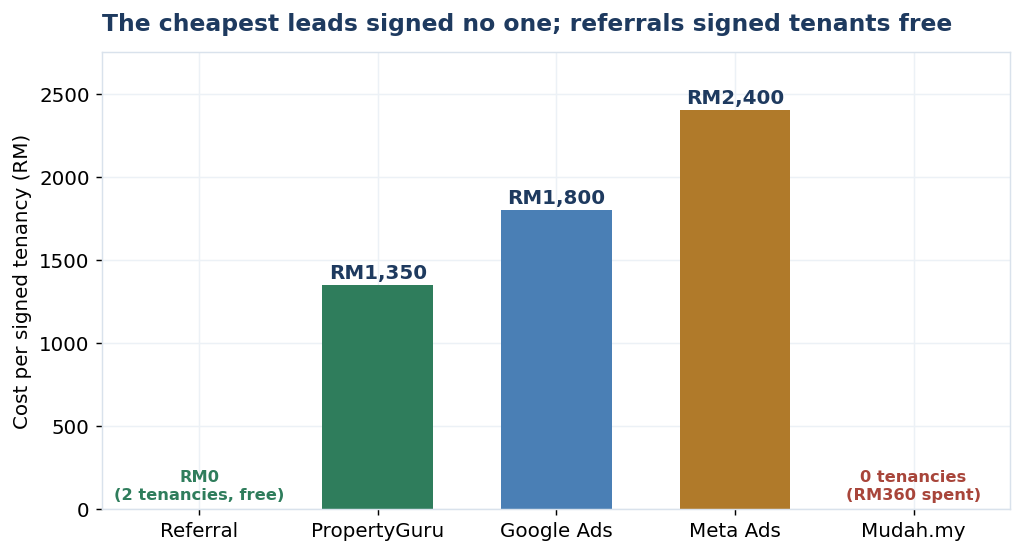
This is the headline. Across six months and RM9,060 of spend, seven tenancies were signed, and the cost to find each one varied enormously by channel. WhatsApp referrals signed two tenants at RM0 each. PropertyGuru signed two at RM1,350 each. Google Ads signed two at RM1,800 each. Meta Ads signed one at RM2,400. Mudah signed none, so its cost per tenancy is undefined: RM360 spent for zero tenants is not cheap, it is wasted.
The most striking result is that the cheapest enquiries produced no tenants and the most expensive enquiries produced the best paid ones. Google Ads had the highest cost per enquiry at RM31, roughly forty times Mudah's, yet it became the second-cheapest source of tenants because half its leads were qualified. Mudah's enquiries cost under one ringgit each and were worth exactly that.
The agent should treat cost per tenancy as the single yardstick for budget decisions. A channel earns its spend by signing tenants, not by filling the inbox, and on that test referrals and PropertyGuru are the workhorses, Google is the quality engine, and Mudah is a free noticeboard that should never receive a paid boost.
3. Where is money wasted on leads that never sign?
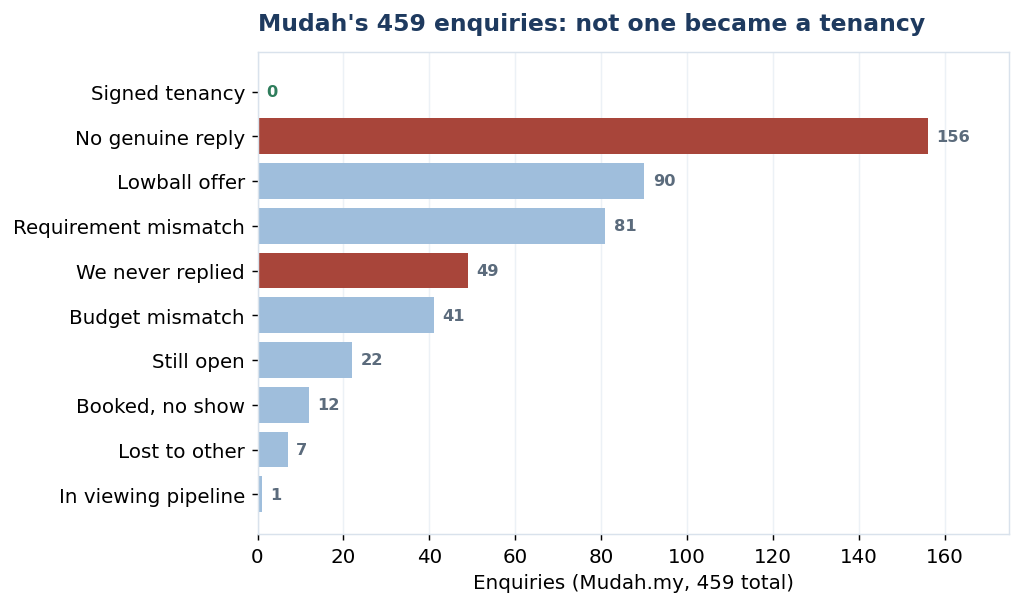
Two kinds of overspending show up, and only one of them is obvious. The visible one is Meta Ads: RM2,400 to sign a single tenant, the worst return of any paid channel. The hidden one is attention. Mudah consumes the largest share of the agency's reply effort, 459 enquiries, while producing nothing: 156 of those enquiries were never genuinely actionable, 90 were lowball offers, and 81 were requirement mismatches. The agency is not overspending ringgit on Mudah, which is nearly free, but it is overspending hours.
Meta's waste is more specific than its headline suggests. Of its 172 enquiries, the 48 aimed at whole units and studios produced zero tenancies; only its room enquiries converted. Roughly a third of the Meta budget is being spent on property types Meta does not sell.
The agent should cut the Meta budget back to room campaigns only, and treat Mudah as a free background listing with no paid bumps and a fast, templated reply so it stops eating the day. The ringgit saved on Meta's non-room spend and the hours saved on Mudah can both move to the channels that sign tenants.
4. Does every channel work for every property type?
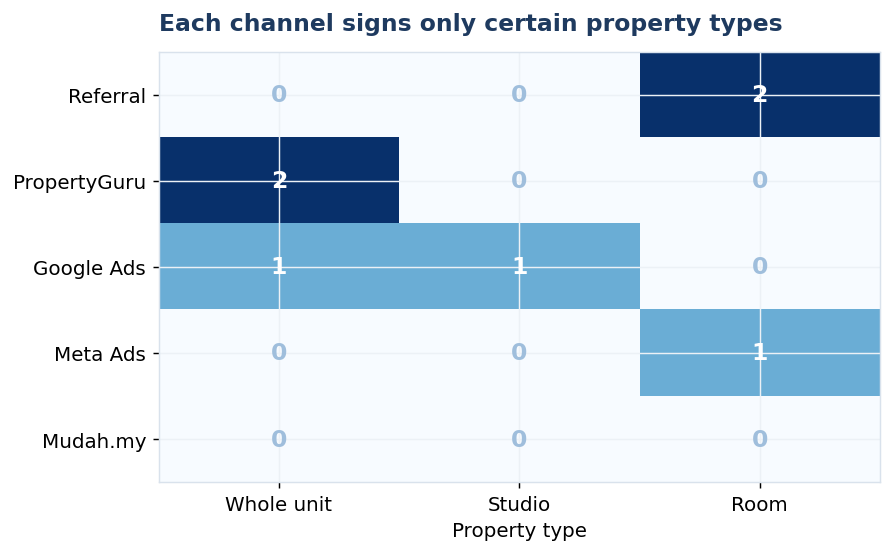
No channel works for everything, and running every listing on every channel burns budget. Meta Ads converted for budget rooms only: its single tenancy came from a room, while its whole-unit and studio enquiries signed nobody. Google Ads was the mirror image, signing a whole unit and a studio but no rooms. PropertyGuru carried the whole-unit signings, and referrals carried the rooms.
This matters because the agency was paying to advertise the wrong property type on the wrong channel. A whole unit promoted on Meta and a room promoted on Google are both spending money where the channel has no track record of converting.
The agent should match the channel to the property: rooms to Meta and referrals, whole units and studios to Google and PropertyGuru. This single change concentrates each ringgit where that channel actually signs tenants, with no increase in total budget.
5. How many paid leads are lost to slow replies?
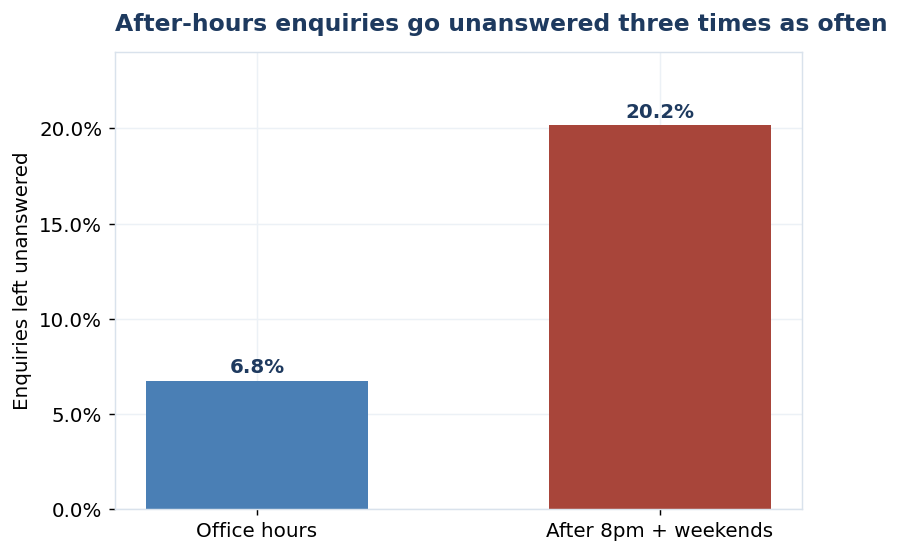
The agency is paying for leads and then dropping them. Across the paid channels, RM682 of enquiries went unanswered over six months, money already spent that never had a chance to convert. The problem concentrates after hours: enquiries arriving after 8pm or at weekends went unanswered 20% of the time, against 7% during office hours, roughly three times the rate, even though one in five enquiries arrives in those evening and weekend windows when renters actually browse.
This is the cleanest money in the report, because it costs nothing to recover. The lead is already bought; the only failure is the reply. RM302 of the loss is purely an after-hours problem that a same-day acknowledgement would solve.
The agent should set up a WhatsApp auto-acknowledgement that fires the moment an enquiry lands after hours, asking three qualifying questions (move-in date, number of occupants, and viewing availability). Holding the lead overnight at zero cost recovers spend that is otherwise written off by morning.
6. Where should the lead budget go next?
The data points to a clear reallocation rather than a bigger budget. The channels that sign tenants (referrals, PropertyGuru, and Google Ads) deserve protected or growing spend, because between them they produced six of the seven tenancies at reasonable cost. The channels that do not (Mudah outright, and Meta outside of rooms) should be downgraded to free or room-only, freeing both ringgit and reply time.
The largest untapped opportunity is the channel that costs nothing. Referrals were the most efficient source of tenants in the entire portfolio, yet they were left to happen by chance. Making the referral ask a fixed step at every signing is the highest-return action available, because it grows the zero-cost channel.
The agent should rebuild the budget around cost per tenancy, formalize referrals, cap Meta to rooms, demote Mudah to a free listing, and protect the Google and PropertyGuru spend that is already working. None of this requires spending more; it requires spending where tenants are actually signed.
Recommendations
- Rank and budget every channel by cost per tenancy, not enquiry volume. The cost to sign a tenant ranged from RM0 (referrals) to RM2,400 (Meta), while Mudah's 40% share of enquiries produced none. Reviewing channels on this measure each month redirects spend from the busiest channel to the one that converts, with no increase in total budget.
- Make a referral ask a fixed step at every signing. Referrals were the most efficient channel in the portfolio: 67% qualified and two tenancies at zero cost. Formalizing the ask grows the only channel that costs nothing, which is the highest-return action available to the agency.
- Cap Meta Ads to room campaigns and demote Mudah to a free listing. Meta signed only rooms and wasted roughly a third of its budget on whole units and studios it never converts, while Mudah consumed the largest share of reply effort for zero tenancies. This frees both ringgit and hours for the channels that work.
- Match the channel to the property type. Rooms convert on Meta and referrals; whole units and studios convert on Google and PropertyGuru. Advertising each listing only on the channels that have signed its property type concentrates spend where it has a track record.
- Add a WhatsApp after-hours auto-acknowledgement. RM682 of paid leads went unanswered, RM302 of it after hours, where the unanswered rate runs three times higher than in office hours. A same-day automated reply with three qualifying questions recovers spend that is otherwise lost by morning, at no cost.
Conclusion
The single most important finding is that the agency's busiest channel was its emptiest. Mudah generated four in every ten enquiries and not one tenancy, while WhatsApp referrals generated fewer than one in ten and signed two tenants for free. Counting leads had been hiding the truth that only counting tenants reveals: cost per tenancy ranged from RM0 to RM2,400 across channels that all looked active in the inbox.
For the business, this is the difference between spending RM9,060 with intent and spending it on autopilot. Every month the agency ranks channels by enquiry volume, it keeps paying Meta RM2,400 a tenant, keeps pouring reply time into a Mudah pile that never signs, and keeps losing RM682 of paid leads to slow replies. The same six months of effort, pointed at the channels that actually convert, signs the same tenants for less and leaves room to grow the free one.
The recommended direction is to manage lead channels by cost per tenancy, not by enquiry count, and to act on the three clear levers the data exposes: grow referrals, fix the channel-to-property match, and close the after-hours reply gap.
Data sources and methodology
We analysed 1,140 rental enquiries received by a ten-listing Klang Valley agency between December 2025 and May 2026, across five lead channels (PropertyGuru, Mudah.my, Google Ads, Meta Ads, and WhatsApp referrals). Each enquiry carries its source, its contact method (portal chat, WhatsApp, phone call, or lead form), whether it was qualified, how quickly it was answered, and its final outcome through to a signed tenancy. Channel costs follow a stated monthly model (PropertyGuru RM450, Mudah RM60, Google Ads RM600, Meta Ads RM400, referrals RM0), with campaign spend attributed to the property segment it targeted and portal subscriptions spread across listings by days listed. The dataset is synthetic and fully reproducible, built to mirror real Klang Valley rental market patterns; the goal throughout was to identify which channel produces signed tenants at reasonable cost, and where the agency overspends on leads that never convert.